
Platform · the shape, not the schematic

Regulation in. Evidence out.
Nothing in between is prose.

Enough to evaluate the design and to know what questions to ask. The full schematic lives in the patents and the diligence room.

§ 01

Three rules that make the record defensible.

LLMs and AI are not deciding whether you are compliant. Our platform of deterministic engines is — and a named person ratifies before anything binds.

I · No model in the path

Deterministic engines decide. A person ratifies.

No LLM anywhere in plan, enforce or prove. Same regulation, same version, same blueprint.

II · Determinism

Once sealed, no reinterpretation.

A sealed blueprint executes without prompt-time interpretation. Identical inputs under an identical version produce an identical trace. That is what makes replay mean anything.

III · No generated evidence

The record is examination, not prose.

Nothing generated becomes a finding. A record states what was examined and what was found, with its reference. A check that cannot be grounded is reported as not established — never rendered as a pass.

§ 02

Four parts. One job: make governance provable.

Each part does one thing, and none second-guesses another. We mark plainly which parts are built today.
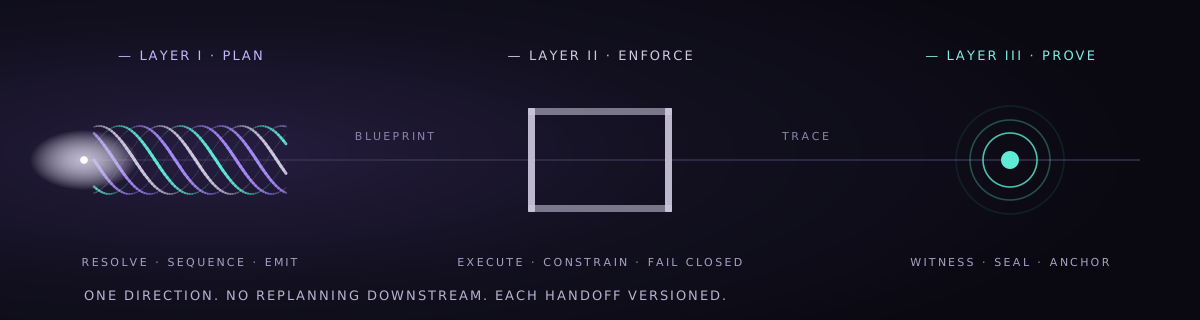
Plan, Enforce, Prove: three layers with a single direction of flow, regulation to blueprint to trace.
FIG. A — Three layers, separable, with a single direction of flow. No re-planning downstream.
01 · Plan

WeaveSynth

Built & verified

Takes in regulation and policy, decides which authority governs, and produces a precise, executable plan — sealed before any work starts. Multi-stage, deterministic. The shape is novel; the details live in the patent.

IngestResolveMapSequenceEmit
02 · Enforce

ISATech

Roadmap

A control engine, a CI/CD bridge, and adapters into IT, OT and IoT systems. Executes the plan exactly as sealed. No re-planning, no interpretation, no room for the plan to drift. Fails closed.

BindExecuteConstrain
03 · Prove

VerdictVault

Roadmap

Signs each step as it happens and stores it tamper-evidently, so the record of what ran cannot be quietly changed afterwards. Replayable, auditor-portable, verifiable without us.

WitnessSealAnchorReplay
04 · Verify — RCatch · roadmap
An independent conformance framework that sits outside the system it checks and re-runs its claims rather than reading them. The witness holds no signing key, so it cannot manufacture a verdict it claims to have observed.
§ 03

What is proven today — and what is not.

We draw the line ourselves, so you can trust the left of it. Status as of September 2026.

Proven today
  • The core proof engine, verified live
  • Core outputs distinguish all four verdicts
  • Evidence sealed, tamper-evident, replayable
  • Import your existing control library
  • Separation of duties — the importer cannot approve
  • Continuous, signed control monitoring (first slice)
  • ISO 42001 and NIST AI RMF content packs
  • Signed remediation — proof a gap was closed
  • One uniform vocabulary on every screen and export
  • Enterprise readiness sweep closed
  • Repeatable demo on live controls
On the roadmap
  • Enforce and Prove layers, productised
  • RCatch — standalone conformance framework
  • Live-system connectors
  • Deeper regulatory coverage
  • Witness-network expansion
Not claimed
  • Continuous operation across a full review period
  • Watching your agent stack directly
  • Anything you cannot re-derive yourself
§ 04

Collecting evidence is not the same as adjudicating it.

Everyone collects evidence and maps it to frameworks. WeaveSynth puts it through an authority chain — and reports four states, not two, because a colour hides three of them.

verified
established and evidenced
blocked
authority missing; did not run
not evaluated
nothing checked here yet
not established
checked; the claim does not hold

Fail-closed at every boundary

No baseline → not established, never healthy. No authority mandate → the run blocks, never completes. No control result → no verified claim, never a silent pass. Absence is never permission.

Replay, not retrieval

A dashboard shows where things stand. WeaveSynth replays how the conclusion was reached — the authority that governed it, the evidence admitted, and the verdict, as of the date you name. That is what a post-incident review asks for.

Separation of duties, in code

The importer cannot approve. The tester does not witness their own test. The fixer cannot close their own finding. Enforced by cryptography, not configuration; every approval carries the approver's signature.

{figure("fig-ungrounded.svg", "The same ungrounded check put to two systems: a conventional system resolves it as pass; WeaveSynth reports it unestablished.", "FIG. C — Same condition. Different answer. The third state is the one that decides whether you ship.", 1128, 316, "")}
§ 05

Your AI, governed.

The record has to survive everything changing: the vendor, the tooling, the team. Nothing in the path was ever a model, so nothing in the record depends on one.
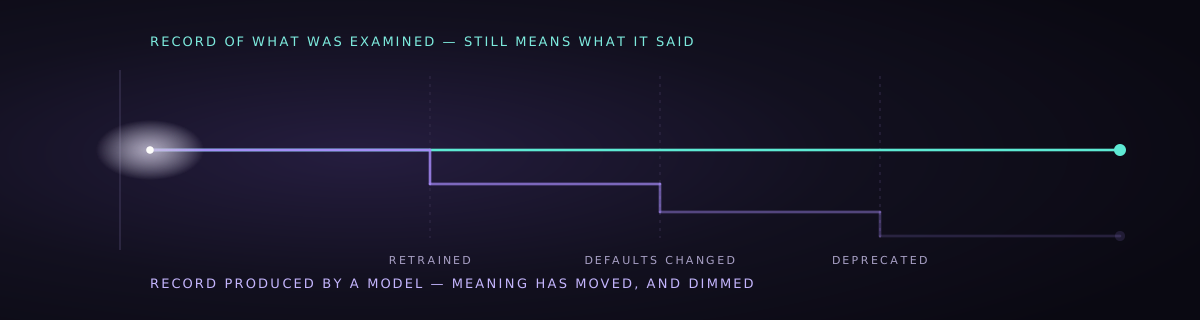
A record that stays whole while the model that helped produce it is retrained, replaced or deprecated.
FIG. B — Retrained, defaults changed, deprecated: the record still means what it said.
Your AI, governed

No AI decides whether you are compliant.

By architecture, not by policy. Your copilots and agents may exist around the platform; nothing they produce can bind a control. Inside the platform there is no model at all.

Your AI may propose

Draft a mapping, suggest a control, summarise a document. Output is marked as a proposal and carries no authority.

Your AI may not decide

No AI-produced artefact binds a control, closes a finding, or satisfies an obligation without a named human act.

Determinism at the gate

Authority resolution, testing, witnessing and sealing contain no model. The same inputs produce the same verdict, every time.

Refusal is the default

Where authority cannot be resolved, the system declines and says so. Absence never reads as permission.

Frameworks answered

EU AI Act Annex IV documentation, NIST AI RMF functions as executable controls, ISO/IEC 42001 mapped once across 27001 and SOC 2 — and model-risk supervision where a supervisor already governs it.

An AI that cannot bind a control cannot go rogue in the control plane. That is a property of where it sits, not of how it is prompted.

§ 06

Adjacent to four categories. Inside none of them.

Enterprise GRC
Holds the policy, the risk register and the board pack, at scale and well. It does not execute. Status is asserted by a person and inherited unchanged — the platform has no way to know whether the control ran.
Compliance automation
Collects evidence continuously across cloud and SaaS estates. It treats a collected status as authoritative: if the source reports green, green is recorded. Nothing establishes that the source was capable of reporting anything else.
ITSM and workflow
Routes the work, holds the approval, keeps the ticket trail. It has no view of which obligation takes precedence when four sources conflict, and no way to compute a correct order.
Policy-as-code
Enforces declarative policy at admission and request time, quickly and reliably. Deciding which of four conflicting authorities wins is upstream of it, and stays manual.

These are complements, not replacements; WeaveSynth is deployed alongside them. The difference is what happens at the edges — when authority conflicts, when a source cannot be reached, when a check does not complete. Every category above resolves that by inheriting a favourable default. This one reports the gap and stops.
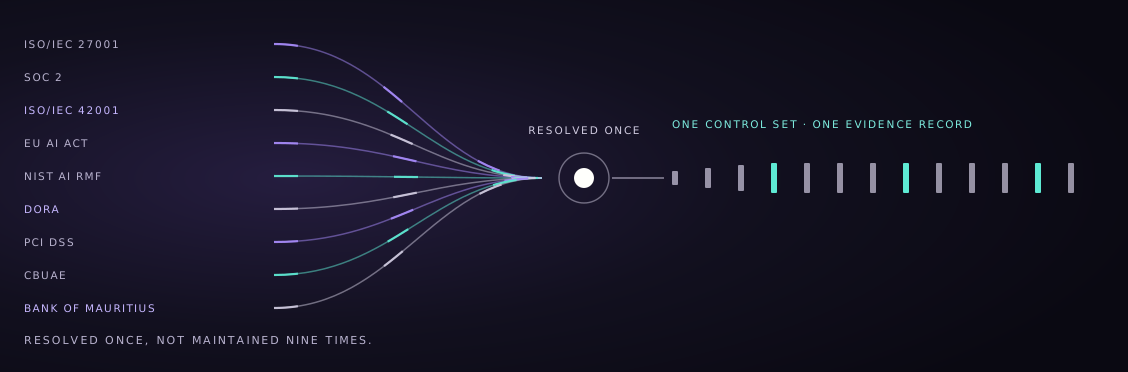
Nine overlapping frameworks resolve into one control set and one evidence record.
FIG. D — Resolved once, not maintained nine times. Where two authorities conflict, the decision is recorded.
§ 07

What a pilot looks like.

Twelve weeks. One mandate. One sealed dossier. Self-hosted on infrastructure you provide; the founder is the technical contact.

Wk 01–04

Bind

Mandate · access · scope

Choose the regulatory mandate. Provision the environment. Confirm scope, escalation paths, and the definition of done.

Wk 05–09

Build

Blueprint · enforcement · trace

Generate the deterministic blueprint, wire enforcement, observe a complete trace through the evidence layer.

Wk 10–12

Seal

Replay · attestation · handover

Replay the trace end to end. Produce the sealed dossier. Hand over a system you can run yourself.
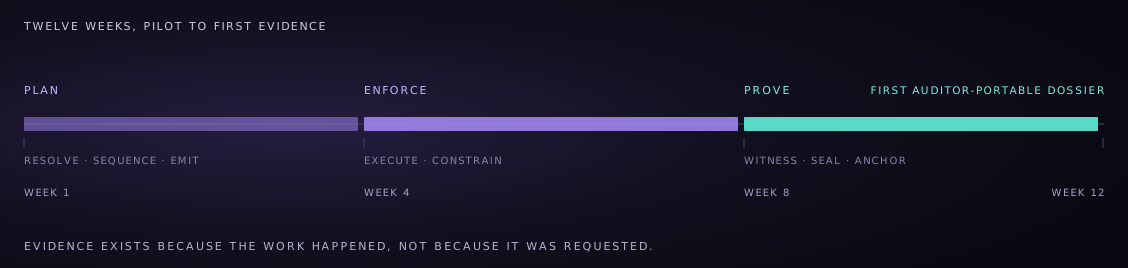
A twelve-week pilot: plan, enforce and prove phases against one axis, ending at the first auditor-portable dossier.
FIG. E — Twelve weeks, pilot to first evidence. Evidence exists because the work happened, not because it was requested.

Default deployment is self-hosted, on-premises, behind your firewall — Docker Compose to begin, your orchestrator at scale. Managed regional cloud (US and Gulf-resident) is an election, not the architecture. Your regulatory text, control set, evidence and keys stay in your custody; if we disappear tomorrow, your evidence is still verifiable.
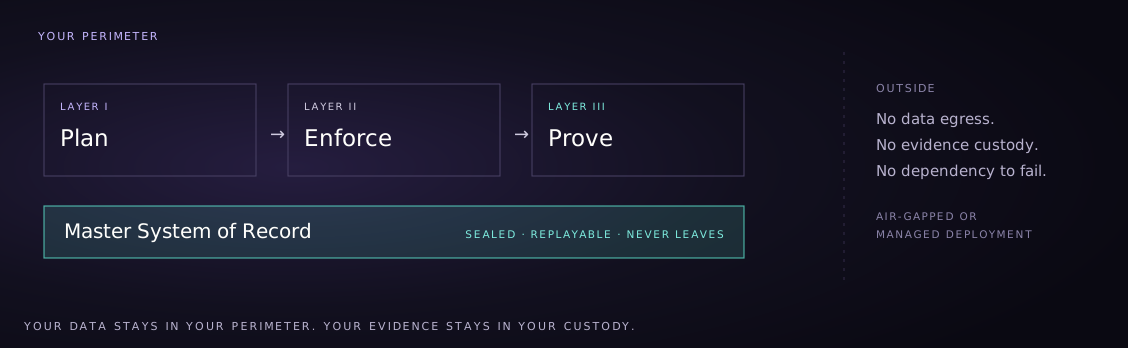
All three layers and the master system of record sit inside your perimeter.
FIG. F — Sovereign by deployment, not by claim. Nothing outside your perimeter holds your evidence.
§ 08

Where each claim stops.

Three boundaries specific to this page, on top of the four on the home page.
The single conduit
Instructions reach downstream systems through one gated path. The gate's refusal behaviour is exercised each release and the result retained, and no override is exposed. The claim is the tested behaviour — not a proof that no bypass could exist.
Independent observation
The observational layer has no write path into execution. Its coverage is bounded by what is instrumented; anything outside that boundary is reported as unobserved, never as clean.
What is built
The planning layer is built and independently verified. Enforce, Prove and RCatch are roadmap and are marked as such above. No claim on this page depends on a roadmap item.
Intellectual property
US patents pending across the layers, filed by the founder. Application numbers, claim coverage and internal design are discussed in diligence under confidentiality — not here.
Logic Axon Shield LLC§ 09 · Begin

Bring your sharpest objection.

Critique calls are scheduled with the founder. An architecture brief is available on request to qualified technical reviewers, advisors and prospective design partners. Thirty minutes. With the founder. No SDR layer, no qualification gauntlet.